What are some advantages to an audio podcast over text-based presentation?
This post is in response to the above question, which was posed by the professor, Anselm Spoerri, in the course podcast here. My response, summarized after the jump, is available here.
What I see as the major advantages of the podcast are getting access to users who can feel overwhelmed by overly hyperlinked and visually "noisy" web presentation. These types of sites are common, and can often turn readers off. Another possible advantage (not mentioned in my response) is accessing users who are quite mobile, and like to have access to internet content while not necessarily being tethered to a device that can display web content. For example, commuters who hate morning radio would perhaps prefer this style of delivery.
If you can't tell (based on this rather lengthy explanation of my response) I am a very visual person, and express myself much better and more thoroughly though writing. I also prefer to digest information through reading and exploring web content myself, rather than having it explained aurally.
I suppose I would be remiss if, after my espousal of the importance of hyperlinking to content, I did not include the appropriate links here. The Sirsi/Dynix podcast can be found here (or the direct feed), and, for a good example of visual "noise," maybe you should check out this good reason to stay away from certain blogs.
Continue reading...
Saturday, March 28, 2009

Friday, March 27, 2009
My first audio story
This ended up being a pretty weak story, mostly because I was testing out the software and trying out the editing. I don't want to ruin the ending, but lets just say it involves me as a child and a bicycle.
Here it is.
Continue reading...
Here it is.
Continue reading...
Monday, March 23, 2009
2009 Shovers & Makers (nominate your bad self!)
Congratulations to me! I have been awarded an honorary student Shover & Maker award from the Library Society of the World.
From the About page:
So anyway, I won, but so did you. And you. Let everyone know at http://www.shoversandmakers.net/ Continue reading...
From the About page:
No one knows what you have been doing all year as well as you do. No one knows what motivates you, what your professional passions are, why you work so hard on behalf of your patrons, clients or co-workers. So only you really know why you are a winner. Please write a quick profile of why you are a winner this year, and it will get published on this site.
So anyway, I won, but so did you. And you. Let everyone know at http://www.shoversandmakers.net/ Continue reading...
Monday, March 16, 2009
The long tail, vol. 2

How do libraries/Librarians fill roles as New Producers, New Markets, and New Tastemakers?
I think this goes back to something that I mentioned last week when we posted about the Long Tail. As we didn't exactly read up on these specific concepts, I'm just fudging here, but based on the simple names, I think I can guess well enough.
New producers? As I have mentioned, librarians have been fulfilling this role by making new content out of what already exists. They take books, provide access to and information about them and produce an environment which cherishes reading. These days, it goes much further than books, and the Long Tail becomes evident in that context. Audio, video, digital content (we all know how much librarians love wikis) all of these are beginning to be collected and disseminated through the library in ways that are beneficial to users, and expansive in terms of simply looking beyond the New York Times Bestsellers List, or even Technorati.
New markets? Libraries have long been an alternative "market" if you want to conceive of it in that way. It is less a market, and more of a marketplace. Instead of peddling wares, libraries and the people who inhabit them come together to make a space that is much greater than the sum or cash value of its parts. Free (and, yes, sometimes illegal) sharing of content and ideas is the principle upon which new markets are being founded everyday. Clay Shirky recently pointed out that we don't know exactly how things are going to shake out, but certainly the mode of information sharing and community participation is active (and completely legitimate) in the library.
New tastemakers? Readers' advisory, reference service, blogs and now Twitter are all ways that libraries have and continue to provide information to users about what is the latest and greatest, or simply unheard of as yet. I guess what I'm saying here is: grow on, Long Tail, we'll keep up. Continue reading...
Friday, March 13, 2009
Blog Analytics
I have been complaining lately via Twitter (not our class account but rather on @danhooker) about how Internet Explorer bothers me. Not only because I am a big proponent of open-source software and open access, but just in general. I have done simple web design in the past and had to battle making ridiculous changes to my CSS just to get an OK render on IE. What a pleasant surprise to me that the visitors to my blog thus far (that's you) are almost exclusively Firefox users!
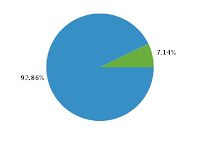 The big blue you see there are Firefox users, and the tiny green speck is the Internet Explorer use. Now, I am not blaming anyone for using IE if they do... it is admittedly quite difficult to get away from when you are Windows user (though now there is word of being able to get rid of it in Windows 7, whee!). I simply think it is a positive thing if so many web readers are using Firefox.
As for connection speed, a majority were Cable internet, but I had a rather large number of "Unknown" speeds. I'm not quite sure what to make of that. Dial-up didn't even register as any visits, so I guess that's progress. Continue reading...
 The big blue you see there are Firefox users, and the tiny green speck is the Internet Explorer use. Now, I am not blaming anyone for using IE if they do... it is admittedly quite difficult to get away from when you are Windows user (though now there is word of being able to get rid of it in Windows 7, whee!). I simply think it is a positive thing if so many web readers are using Firefox.
As for connection speed, a majority were Cable internet, but I had a rather large number of "Unknown" speeds. I'm not quite sure what to make of that. Dial-up didn't even register as any visits, so I guess that's progress. Continue reading...
My ed-experience
Falling into coming to school in Vancouver for me was primarily motivated first by place, then by price, then by sheer luck I think. I came from the University of Wisconsin, where, as you may know, there is a library school and one that is looked fairly well upon (or so I hear). I had a job, I had friends there, so in many ways it would have been ideal, but I guess I was just ready to leave. Madison is a wonderful community and I secretly hope to make it back one day, but at the time of the decision, I'm sure now that it was the right thing to leave.
You can see the pictures that I uploaded to describe my "ed experience" here. The whole class project group is here. I first entertained the notion of coming to Vancouver for graduate school because I had heard such good things about living in the Pacific Northwest. Then I saw the tuition rates. A calendar year at SLAIS runs me $7,200 CAD. All UBC graduate students are required to maintain a year-round relationship with the school, so that price is for 2 normal semesters, and both summer terms regardless of whether I enroll in classes.
To compare, fall and spring semesters at UW-Madison are $5,600 USD, plus $4,100 for summer (if I chose to enroll). That is a total of $15,300 for the year. More than double! I couldn't believe it, and started working immediately on my application.
I always have to temper my enthusiasm with the fact that the cost of living in Vancouver is much higher than in the States (though perhaps not New York City, as those of you living there may attest) so that evens things out a bit. But either way, that turned my Pacific living dream into a reality.
So what else can I say about my education experience here? It is a time of political struggle at SLAIS, but that makes it a good time to be around in many ways. We are currently conducting a series of interviews for the school director positions (the candidates are currently confidential) as well as for two open faculty positions. It has been very interesting to be in on the process of selecting a new figurehead for the school... for example, I am personally very interested in technology so it was hard for me to like (though I did end up liking) one candidate whose research interests were of a more humanist bent. I have a background in the Humanities, but I'm not sure that's where the field of LIS needs to be heading.
 Along those lines, I have been talking with several of my peers about desiring more technology oriented classes in the SLAIS curriculum. There are some, though none along the lines of web development and design, which I am personally interested in as it applies to our field. They are offering a social media course next fall which I am happy about, but I'll have already been in this one. I know there are options outside of SLAIS for courses such as these, but that is difficult and there has been little outreach between departments so far in my experience.
This is not to say I am unhappy here. Overall, my experience in the classes I have taken have all been very positive, and though there is some want for a larger, stable faculty, the base faculty here now is solid and they have all been very warm and welcoming of new students, and, now that I am one, of continuing students as well.
Well. I think I've said enough. There is more of course, but I will spare you. If you're interested in talking more just let me know. I could go on, I am sure. Continue reading...
You can see the pictures that I uploaded to describe my "ed experience" here. The whole class project group is here. I first entertained the notion of coming to Vancouver for graduate school because I had heard such good things about living in the Pacific Northwest. Then I saw the tuition rates. A calendar year at SLAIS runs me $7,200 CAD. All UBC graduate students are required to maintain a year-round relationship with the school, so that price is for 2 normal semesters, and both summer terms regardless of whether I enroll in classes.
To compare, fall and spring semesters at UW-Madison are $5,600 USD, plus $4,100 for summer (if I chose to enroll). That is a total of $15,300 for the year. More than double! I couldn't believe it, and started working immediately on my application.
I always have to temper my enthusiasm with the fact that the cost of living in Vancouver is much higher than in the States (though perhaps not New York City, as those of you living there may attest) so that evens things out a bit. But either way, that turned my Pacific living dream into a reality.
So what else can I say about my education experience here? It is a time of political struggle at SLAIS, but that makes it a good time to be around in many ways. We are currently conducting a series of interviews for the school director positions (the candidates are currently confidential) as well as for two open faculty positions. It has been very interesting to be in on the process of selecting a new figurehead for the school... for example, I am personally very interested in technology so it was hard for me to like (though I did end up liking) one candidate whose research interests were of a more humanist bent. I have a background in the Humanities, but I'm not sure that's where the field of LIS needs to be heading.
Along those lines, I have been talking with several of my peers about desiring more technology oriented classes in the SLAIS curriculum. There are some, though none along the lines of web development and design, which I am personally interested in as it applies to our field. They are offering a social media course next fall which I am happy about, but I'll have already been in this one. I know there are options outside of SLAIS for courses such as these, but that is difficult and there has been little outreach between departments so far in my experience.This is not to say I am unhappy here. Overall, my experience in the classes I have taken have all been very positive, and though there is some want for a larger, stable faculty, the base faculty here now is solid and they have all been very warm and welcoming of new students, and, now that I am one, of continuing students as well.
Well. I think I've said enough. There is more of course, but I will spare you. If you're interested in talking more just let me know. I could go on, I am sure. Continue reading...
Labels:
ed-experience,
scils598s09,
slais,
ubc,
vancouver

Sunday, March 8, 2009
pbwiki v. wetpaint
 The battle of the free wiki programs. The first thing to notice about Wetpaint as opposed to PBWiki is the coding. Wetpaint's design is filled to the brim with cutting edge web stuff like floating toolbars for page editing, collapsible everything and transparency a-go-go. PBWiki keeps it a little simpler in this regard, and I can't quite decide which I prefer. Being a web design fan myself, I can appreciate the effort which it must have required to develop Wetpaint's functionality, but it seems perhaps that the money spent on design has to be made up by advertisements or membership fees.
This is, of course, not exactly an unfamiliar model for web applications, but coming from using PBWiki which has run both membership-free and ad-free since I have used it, it does take a little getting used to. I find that I use wikis the most for group planning or project development. In that context, having ads run on the sidebar is pretty unappetizing.
That being said, watching the CommonCraft video on WetPaint provides a different perspective on how Wetpaint is trying to develop its user base. These are not supposed to be wikis for a group of students planning out a project. Wetpaint is catering toward the book and fan club users, seeking to find a home on the web. This sense is heightened by the easy addition of page "modules" and "widgets" that connect your Wetpaint wiki to other web services like YouTube or iMeem. It also breaks some of the contextual barriers around the presence of ads. I am more comfortable seeing ads on Amazon Recommends, than I am on Google Docs.
In this course, we are already used to PBWiki, and it seems to serve the purpose of planning out the course quite well. The traditional WYSIWYG editor of the PBWiki pages is familiar, and with no ads lurking around it feels more like a learning space than Wetpaint.
Given my usual desires for a wiki, I think I'll stick by PBWiki (as long as they keep it free, anyway). But, given the enhanced functionality of Wetpaint, it certainly would be something to consider for other users. Continue reading...
Subscribe to:
Posts (Atom)

