The question: Do RSS and XML feeds worsen or help with the woozy side-effects of information overload?
Answer: I think it helps, but I am sympathetic to those that disagree.
I remember having a conversation about two years ago with a friend who was saying he liked the experience of actually navigating to the blogs that he liked to read and finding new posts, as opposed to using a feed reader. Part of the reason why he liked reading blogs was that each one presented itself in a different manner (see my post below for more on that particular issue) and that visiting each one to find the content was all part of why he read blogs in the first place.
Sometimes I wonder if he still sticks to this fundamentalist strategy, but I mostly figure that it simply cannot be true anymore. There is simply too much. He went on to be an editor somewhere, and I believe is now a writer, and that just can't be practical any longer.
Does this mean that all is lost, and we are slowly developing tunnel vision, peering at the information through our Google Reader "All Items (1000+)" page? Certainly not everyone, but often I fantasize of paring my list of 50 blogs down to a more manageable 10, eliminating those pesky Boing Boings and Gizmodos for something that posts a more reasonable 1-2 times a day. But what will I miss? What will I mention is funny and interesting at class tomorrow if I have eliminated Gawker from my reader? There they sit, 20 or 30 posts each day, racking up pale white lines of unread posts that stay unread, while I remain subscribed, mired in my own indecision.
And yet, without the option to embed information streams in such a reader, or on a web page, or on this blog, the Internet as we know it would provide so much less utility, fun, excitment and efficiency. So much of the exciting developments of the Web in the past 5 years has centered around the ease with which people can share information, instead of just finding it. This, I believe, helps ease the burden of information overload. The ability to quickly see and evaluate information that is shared or syndicated by others provides such a boon to those who want to find it. Before, we may have known something was out there, but we would be at the mercy of the entire sprawl of the World Wide Web. At least with a feed reader full of 50 blogs, I know that what I want is inside; now I just have that list to grapple with.
Continue reading...
Showing posts with label rss. Show all posts
Showing posts with label rss. Show all posts
Tuesday, February 17, 2009

Monday, February 9, 2009
bloglines v google reader
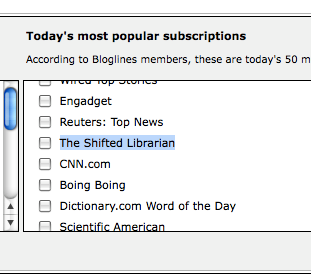
I am not going to pretend neutrality on this issue. I started reading feeds a few years ago to get through the workday in a library office without windows. My first feed reader was a desktop client (had to download and install it) called BottomFeeder. My supervisor used Bloglines so I set it up, too, but quickly found it too clunky to use. Then I found Google Reader and my life hasn't been the same since.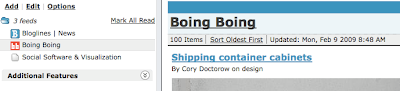
Regardless, I won't be switching back anytime soon. Continue reading...
- Google Reader has collapsible windows for each post. This makes it easy to see what you have and have not read, and what you are reading and what you are not reading.
- Bloglines does not have this.
- Google Reader has a clean interface. Bloglines does not have this.

- When I subscribed to Boing Boing in Bloglines, it said I had 200 unread posts. After clicking on it once, they were all marked as read! When I came back, nothing appeared.
- A positive thing: the "playlist" function, where you can customize groups of feeds to read together, is something that, to my knowledge, you can't do in Google. If you organize by folders, however, it is easy to achieve this effect.

Regardless, I won't be switching back anytime soon. Continue reading...
Labels:
aggregators,
bloglines,
google readers,
rss

Subscribe to:
Posts (Atom)

